
Construction
Why talk-down is the fastest way to protect a construction site after hours
People get onto jobsites at night, and an open site can hurt them. A live voice on a speaker warns them off in seconds, while they are still at the fence. A patrol car or police unit needs minutes to arrive.
VuePoint
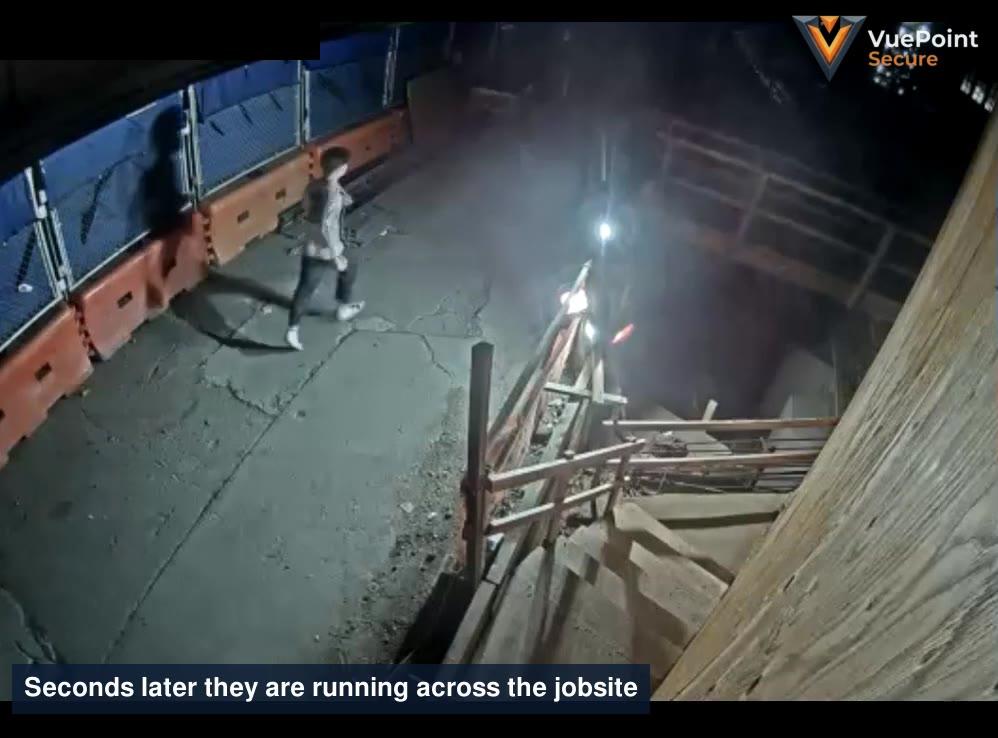
A talk-down system lets a live operator speak through a speaker on the site the moment a camera shows someone who shouldn't be there. It is the fastest response a construction site has: the warning lands in seconds, while the person is still at the fence. A patrol or a police unit has to drive there first. That speed matters because a jobsite at night is dangerous as well as valuable. The people who climb in are often not there to steal. They are curious, or taking a shortcut, or looking for somewhere to hang out. They walk into open edges, stairs without rails, rebar and equipment in the dark.
What a jobsite trespass actually looks like
Look at how the clip unfolds. The group stands at the wall for a while before anyone climbs. Then they drop down into an active site at night, past railings, stairs and drop-offs, with no lights on the areas they're walking into. If something goes wrong, the outcome you're dealing with isn't a stolen tool. It's an injured person on your site.
People get in, and people get hurt
A construction site is built to be safe for trained crews in daylight, wearing PPE, with the hazards marked and the site supervised. At 2 a.m. none of that applies. Falls are the leading cause of death in construction, according to OSHA. The same openings, edges and ladders are there at night, only now nobody can see them.
- Open edges and floor openings. Slab edges, shafts and stairwells that aren't closed in yet.
- Excavations and trenches. Easy to miss in the dark and hard to climb out of.
- Scaffolding, ladders and cranes. A climb that's tempting at night and dangerous for someone untrained.
- Materials and equipment. Rebar, stacked materials and parked machines, all in poor light.
- Groups egging each other on. It's rarely one careful person. More often it's a few people daring each other.
When someone gets hurt, the owner and the general contractor end up with the injury, the investigation and the paperwork, and sometimes a claim, even though that person had no business being there. Fences and signs are a start. But a fence doesn't speak, and a sign doesn't notice someone climbing over it at 2 a.m. Ask your insurer or attorney how a trespasser injury would play out on your specific project.
Why a voice warning is the fastest response
Every other option has to travel to the site. Talk-down doesn't, because the speaker is already there. As soon as the operator sees the person on camera, the warning goes out over the site, and it can name what the person is doing: "You in the white shirt on the wall, this site is monitored and you are being recorded. Get down and leave now." Most people don't expect a live voice to address them specifically, and that is what makes them turn around.
| Response | What has to happen first | How long it takes |
|---|---|---|
| Live talk-down | Camera alert, operator verifies, operator speaks through the on-site speaker | Seconds. The person is often still at the fence. |
| Siren and strobe | Triggered with the talk-down | Seconds. Loud, but it can't tell them who is watching or what to do. |
| Mobile patrol | Someone calls the patrol company, then a car is sent from wherever it is on its route | Minutes at the very least, often much longer |
| Police | A 911 or non-emergency call, then dispatch prioritizes it against other calls | Varies widely. A trespass with nobody hurt is rarely the top priority. |
Patrols and police still have a role, especially when someone refuses to leave or damage is already happening. But by the time either one arrives, the person is already deep in the site or has already left. Talk-down acts in the window that decides whether anyone gets hurt: the first minute, at the perimeter.
How VuePoint talk-down works on a jobsite
VuePoint operators watch alerts from your site's cameras live. When the AI flags a person after hours, an operator checks the video, speaks through the talk-down speaker on site, triggers the siren and strobe when needed, and alerts your team. The cameras can be ones you already have, through our edge device, or a RapidDeploy tripod unit with its own siren and strobe for sites that don't have power or poles yet.
How to set up talk-down on a construction site
- 1
Cover where people actually get in
Point cameras at the low walls, gates, gaps in the fence and neighboring rooftops, not just at the trailer. In the clip above, the way in was a low wall next to a public walkway.
- 2
Put speakers where they'll be heard
Mount speakers within earshot of each entry point, so a warning reaches the person at the fence and not just the middle of the site.
- 3
Alert on people, not on motion
Use person detection with after-hours schedules and detection zones that cover the site, not the sidewalk, so operators only see the alerts that matter.
- 4
Agree on the script and the escalation
Decide in advance what the operator says, when the siren goes on, who on your team gets alerted and at what point your team calls the police.
- 5
Arm the system whenever the crew leaves
That includes nights, weekends and holidays, the hours when a site is empty and most attractive to anyone looking to get in.
Common questions
- What is a talk-down system for construction sites?
- A talk-down system is a speaker on the jobsite that a remote operator can talk through live after a camera detects someone on site. The operator warns the person that the site is monitored and tells them to leave, usually within seconds of the alert.
- Is talk-down faster than a security patrol?
- Yes. Talk-down starts as soon as an operator verifies the alert, because the speaker is already on site. A patrol has to be called and then drive to the site, which takes minutes at best.
- Does a talk-down replace calling the police?
- No, it comes first. The voice warning handles most people at the perimeter, and your agreed escalation plan covers the cases where someone refuses to leave or damage is already happening.
- Can I add talk-down to the cameras I already have?
- Often, yes. VuePoint can connect to many existing camera systems through an edge device, and speakers can be added at the entry points. For sites without power or poles, a self-contained tripod unit includes cameras, a siren and a strobe.
Put a live voice on your jobsite
Tell us about your site and we'll show you where the cameras and speakers should go.